28th November 2025
YMa, Pontypridd
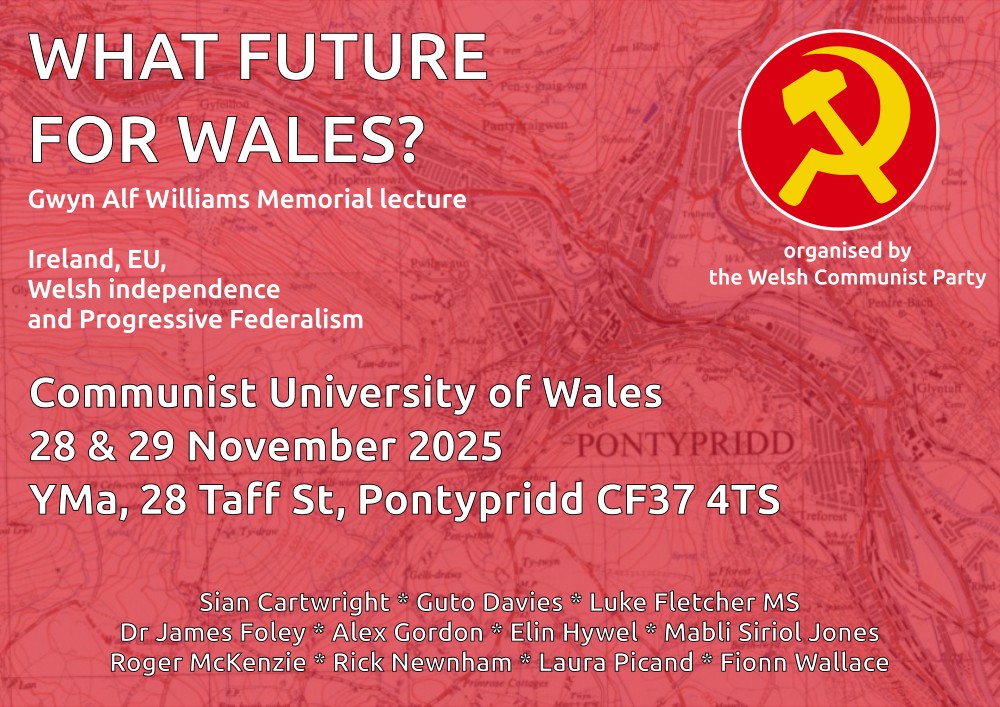
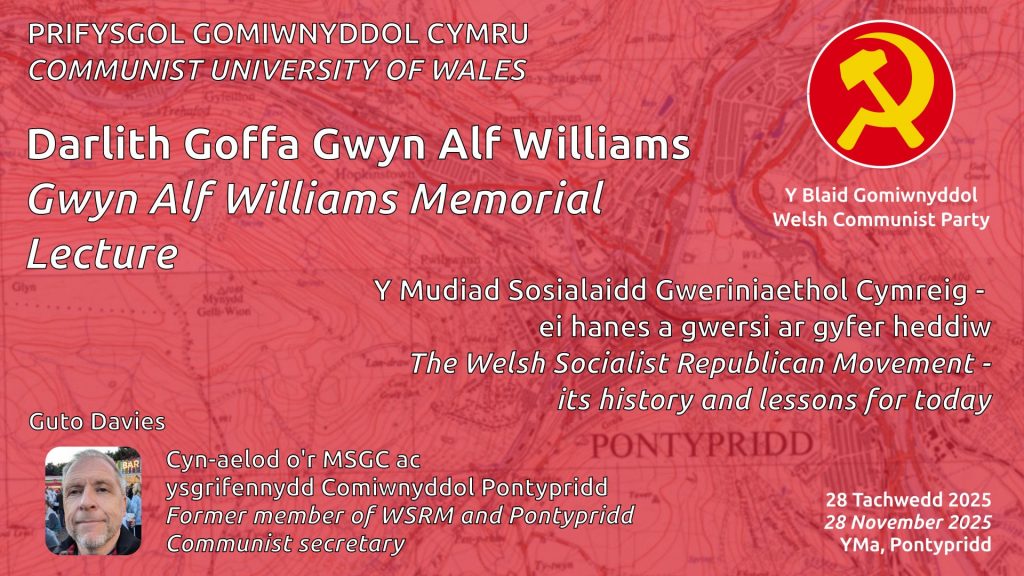
As part of the Communist University Of Wales, Guto Davies delivered the 2025 Gwyn Alf Williams Memorial lecture on the Welsh Socialist Republican Movement.
The full lecture is available on the Communist Party’s YouTube channel:
The full transcript of the lecture is available here:
The Welsh Socialist Republican Movement – its history and lessons for today
It is a great honour, it was something of a shock, to be asked to present the Gwyn Alf Williams lecture this year, an honour of course because of the man that we commemorate, the historian, marxist, patriot, proud Dowlais-Merthyr boy Gwyn Alf, who small of stature, communicating with a slight stammer, was a larger than life character who projected himself and his ideas on to the minds of so many of us back in the 1970s and 80s. Those were the decades when Gwyn Alf was in his pomp, in terms of his popularity, especially so with the screening of the TV series The Dragon Has Two Tongues.
It was a turbulent time politically in Wales, in Britain and beyond, and it was the era during which a political entity came to the fore in this land, the subject of this lecture, the Welsh Socialist Republican Movement, which I will refer to, as it was back in the day, as the WSRM.
As I said Gwyn Alf was a Marxist, a one time member of the Young Communist League and the Communist Party, also a patriot and a republican who later became a member of Plaid Cymru. His political migration in a way reflected the identity crisis, the split personality of the WSRM itself, which with hindsight I believe was the main reason for the movement’s subsequent demise.
The WSRM, to quote the Welsh poet R Williams Parry, when he saw a fox fleetingly cross his path on a remote mountain top – “digwyddodd, darfu megis seren wib” it happened, it ended, like a shooting star. The movement lasted only a few brief years, to an extent lit up the political sky in Wales, before it imploded into its own black hole.
To put everything into a historical context, there had previously been a tradition of die-hard republicanism, with a definite socialist leaning, in Wales. Amongst its ranks in the 1950s and 60s were prominent figures such as Ithel Davies and the future Labour MP and Lord Gwilym Prys Davies. Some of the old republicans such as Cliff Bere and Harri Webb became involved again, as revered old-timers, in the newly formed WSRM of the 1980s.
Again, looking at the history, and at the 1970s in Wales, towards the end of that decade, Margaret Thatcher came into power as Tory prime minister, there was a calculated attack on the traditional heavy industries in Wales, coal and steel, and the trades unions that represented those workers, the first referendum for devolution ended in a heavy defeat and just across the water in Ireland there was big trouble brewing that culminated in the death by hunger strike of ten republican political prisoners.
All these were significant factors woven in to the creation of the WSRM in 1979, which came predominantly from a socialist faction within Plaid Cymru, with Robert Griffiths, Gareth Miles and Tim Richards as the protagonists, who were becoming more and more disillusioned with the ineffective cultural nationalism of its leadership, personified by Gwynfor Evans. Gwynfor would himself later be prepared to go on hunger strike for a Welsh language tv channel, but showed little fighting spirit in defence of the Welsh working class against the attacks of Thatcherism.
I came into the WSRM not as a member of Plaid Cymru but having grown up in the 1960s, with Che Guevara and Ho Chi Min as heroes from afar, with an awareness of the Prague spring and the Paris insurrections, and closer to home having childhood memories of the Aberfan disaster, the drowning of Capel Celyn under the Tryweryn reservoir and the Investiture of the Prince of Wales along with the MAC bombing campaign in response to it, I was very open to the idea of a Welsh Socialist Republic. I had been reading a bit of Lenin and James Connolly, and as the WSRM was being formed Gareth Miles, who was writing a pamphlet about the great man Connolly, asked me to translate some of his essays into Welsh, which was a defining experience and drew me head on into the new movement.
I was present at, what I believe was the inaugural meeting of the WSRM in Ty’r Cymru, off Richmond Road in Cardiff, where a diverse group of socialists, trade unionists and patriots got together informally to get things going. And so for me began a four year roller-coaster ride, no doubt boosted by an adrenaline rush of romanticism and sometimes blurred by excessive levels of alcohol, with trips to Ireland and Scotland for clandestine meetings, mixing with Marxist intellectuals and republican rogues, once or twice getting locked up in police cells, one of which was for firing a flare at the aforementioned and much despised Margaret Thatcher – they were the best of times, the worst of times.
I must say from that very first meeting in Ty’r Cymry there were red flags, not of the communist variety but danger signals, that the whole venture might become unstuck, it was a very diverse grouping present that day, many still active in Plaid Cymru, some following a Marxist ideology, some republicans in the purely nationalistic sense, some as they would be called in Ireland “Guinness republicans” or as we dubbed them here in Wales “Albright republicans”, a far less potent brew. At a later date there was an influx of died in the wool anarchists and the WSRM over its four year existence, became everything to everyone and ultimately nothing to anyone.
The political agenda as projected in its first publication ‘Sosialaeth i’r Cymry / Socialism for the Welsh People’ written by Rob Griffiths and Gareth Miles was without doubt Marxist in ideology and based on a class analysis of history and society, and that document is still relevant today, having been reprinted by the Communist Party last year. Maybe the ensuing problem was that not everyone who joined the WSRM was duty bound to follow its ideology and analysis. I can not remember the term ‘democratic centralism’ being mentioned in the movement’s proceedings.
The first official national congress of the WSRM, following an earlier summer school in Aberfan, was held just up the road from here in Hopkinstown in 1981 and the very first resolution was worded as follows, quote: “We declare ourselves part of the international struggle for Socialism, for a society where all economic and political power is in the hands of the working class. We believe that the fight for Socialism should, in Wales, take the shape of a National Liberation Struggle… that the working class should, in its own interests, lead the people of Wales in a campaign for a Welsh Socialist Republic.” Unquote. There were other motions to follow on subjects such as the oppression of women, the Welsh language, industrial and trade union campaigning, the British state, inequality, imperialism and so on, and a constitution for the new movement was confirmed, based on local branches or clubs feeding into a national committee, with two flagship publications, the Welsh Republic in English and Y Faner Goch (of which I was for some time editor) in Welsh.
It seemed that a sound ideological basis and structure had been laid. The reality, as time would tell, a little different. The WSRM in line with its Marxist ideology took an honourable lead in campaigning and marching in support of the striking miners, the Llanelli tinplate and Port Talbot steel workers, in being the first to commemorate the Llanelli rail strikers killed in in 1911. Look back at the documents covering the movement’s history now and you will barely find a mention of this, only of links with the IRA, of bombing and arson campaigns sensationalised by the media.
Some standout memories that I have of those heady WSRM days, and nights, are of marches through Cardiff in support of the Irish hunger strikers and in memory of Bloody Sunday, which whipped up both solidarity and hatred from the local population, marches through Abergele led by a fife and drum band put together by former MAC bomber John Jenkins, in which I was a one-time drummer, to commemorate his two accomplices killed by their own device in 1969, of demonstrations such as the one in Port Talbot where, following a march in support of the steelworkers led by Newport Labour MP Paul Flynn, we moved on to nearby Margam Park to sportingly wreck a British Army recruitment fair, of a rally in Llangrannog highlighting the housing crisis in the context of holiday home ownership, where as a speaker I shared a platform with future Lord of the Realm Dafydd Ellis-Thomas, of a riot in Merthyr involving a Scottish fife and drum band, and I do mean a riot of west of Scotland proportions, of trips to Dublin and Glasgow to meet socialist republicans, famous and infamous, of meeting one day with Nan Milton, daughter of the great Red Clyde leader John McLean, and that night meeting the mother of Celtic, Manchester United and Scotland footballer Paddy Crerand, along with some IRA volunteers who were also in attendance in a Gorbals pub, the only building left standing on a slum clearance wasteland. I promise you there was rarely a dull moment.
We often carried out our activities with a sense of humour and of mischief, again I’ll offer a few examples, if only to lighten the mood of this lecture. In that first congress at Hopkinstown, a veteran Marxist from Brecon, old Arthur Evans, taking to the stage to propose a motion in support of Albanian revolutionary leader Enver Hoxha, speaking for his allocated time before being stood down by the chairperson, who then asked if anyone wished to speak against the motion, and up came Arthur Evans again, as, he explained, he agreed with most of what Hoxha was doing but not everything, taking up more congress time to speak against his own motion. That was democratic centralism with the emphasis on the democratic right to talk in contradictions for a long time. There was the social event during the Machynlleth national eisteddfod for which we sold only one ticket but as the venue and the bands had been booked, decided to go ahead anyway. A huge crowd turned up on the night, packing out the venue, and then along came the buyer of that solitary advance ticket and, yes, we had to turn him away. There were the ‘Dear Nick’ spoof letters to Welsh Secretary of Sate Nicholas Edwards which attracted significant media attention, the badges we produced and continuously sold out during the Meibion Glyndwr arson campaign, bearing the logo of an England’s Glory box of matches and the words below – “strike a light for Wales”, along with posters picturing holiday homes with the words of the National Coal Board adverts “come home to a real fire” and in Y Faner Goch, a cartoon strip based on Mistar Urdd the cuddly mascot of the very respectable Welsh League of Youth, but this one wearing a beret and dark glasses and armed with a kalashnikov, known as Provisional Mistar Urdd.
Fun and games there might have been aplenty but against a backdrop of serious social unrest in Wales, which manifested itself in extended and increasingly sophisticated arson and bombing campaigns, the WSRM was drawn directly into confrontation with the powers of the British State. Some of the movement’s leading members appeared on television, not advocating violence but justifying it, and the WSRM was linked, rightly or wrongly in the media with the bombing campaign instigated by the WAWR, the Workers’ Army of the Welsh Republic. People involved in the movement were arrested, as happened here in Pontypridd after an explosion at the Army Recruitment Office which was located just across the junction from where we are this evening. Everything came to a head with the showcase conspiracy trials of 1983 in Cardiff Crown Court involving many members of the WSRM including its leading light Robert Griffiths. Due to the principled stance taken by the defendants, and the proven corruption and ineptitude of the police, the trial collapsed but a great deal of damage had already been done. The Welsh Campaign For Civil Liberties and the Welsh Political Prisoners Defence Committee had been formed in response to such gross injustices. Was it the British State and the South Wales Police then that caused the demise of the Welsh Socialist Republican Movement? No, I believe they merely exerted one last twist of the knife into a body that was already dying by its own hand.
Much of the WSRM’s activities, in contrast maybe to its stated ideology, focussed on an aggressive republicanism, on to the flames of which a measure of anarchist fuel was poured. As noble as were its aims it was not fit for purpose. Robert Griffiths himself summed it up after the conspiracy trial and I quote: “There was an unholy alliance between nationalism and ultra-left anarchism that undermined what the WSRM was intended to become, a socialist party of the Welsh working class. A small number of people were able to disrupt and divide the WSRM because there were contradictions in the movement’s political basis for them to utilise.” Unquote. Gareth Miles, the deep thinker behind the movement’s formation, had realised early on that it was moving in the wrong direction, and increasingly backed away from his leadership profile although remaining loyally supportive of those persecuted by the state.
What are the lessons then, briefly, to be learnt from what occurred between 1979 and 1983 in the name of the Welsh Socialist Republican Movement? And this is the tricky part of the lecture for me as I am no political philosopher or analyst – the Communist University meeting here tomorrow will no doubt delve far deeper into the issues of national liberation, of internationalism, of progressive federalism and nationalism. I can only tell it as it was. I was a fairly naive twenty year old at the time going into the adventure that was the WSRM but the whole movement was naive in terms of many of its members thinking that events in Ireland could be replicated here in Wales, thinking that the cavalier actions of old republicans and patriotic warriors could galvanise a Welsh working class that was being systematically attacked in purely economic terms by Thatcherism. For all the policies printed in manifestos and congress resolutions, political discipline did not bind together the grass roots, without an extensive political education embedded in democratic centralism.
The ultimate aim of a Welsh Socialist Republic is a noble one, worth fighting for, but the road taken towards it must be travelled in a principled and disciplined manner. As a Marxist I apply the analysis that society is based on class, that the failing capitalist system must be dismantled before it destroys the very earth on which we live, that the working class in world-wide unity must emancipate itself and bring in a new era of equality, justice, peace and hope. That analysis is based on the revolutionary philosophy of Marx and Engels, as taken forward by Lenin. If imperialism is and undoubtedly it is, the highest stage of capitalism, the parasitic, moribund, final stage of capitalism, then the battle to undermine it will be one for the emancipation not only of the global working class but also of the various nations to which that working class belongs, that will be the practical means to the end. Lenin saw that clearly, as did our own T E Nicholas here in Wales, as did Connolly, MacLean, Che Guevara, Ho Chi Minh and other great revolutionaries.
There is no contradiction in terms in equating class emancipation with national liberation, and why fight for a Welsh Republic of any kind unless the corrupt and unjust system of capitalism is swept away in the process? Our Welsh identity, our language, as it was at the time of the Merthyr Rising and the Chartist Insurrection of the 19th century, can be vital components of the social revolution that we yearn for. Taking the Monopoly board direct route – go straight to a Welsh Republic, do not pass Go – as Yes Cymru or to an extent Plaid Cymru might advocate, without thinking through clearly the class and economic foundations of that new ‘Cymru Rydd’ would be a futile excercise.
Would that nation remain a dominion paying homage to the British Crown, would it be a member of NATO, of the European Union, would it welcome investment by global monopolies that would continue to subjugate and exploit its working class, would its economy be manipulated by the corporate banks, would its health system, transport infrastructure, utilities, energy and wind farms be brought into public ownership or continue to be scavenged by multinational companies ?
The path being advocated by the Communist Party is that of Progressive Federalism which recognises a common class struggle across the whole of what is currently known as the United Kingdom and recognises also the unique cultural identities and rights of self-determination of the nations within these islands. A Welsh Socialist Republic can be achieved through this process, as an equal member of a federal Union of British Socialist Republics.
If there is a lesson to be learnt from the existence and the demise of the old WSRM, it is that the road to that ideal must be followed with discipline, with a clear understanding of the class struggle, and that the Welsh working class, y werin, must be in the vanguard at all times as it frees itself from the overbearing chains of capitalism and imperialism. And so I can say tonight, in hope and with certainty, as I did four decades ago – Forward, to a Welsh Socialist Republic – Ymlaen i’r Weriniaeth Sosialaidd Gymreig.