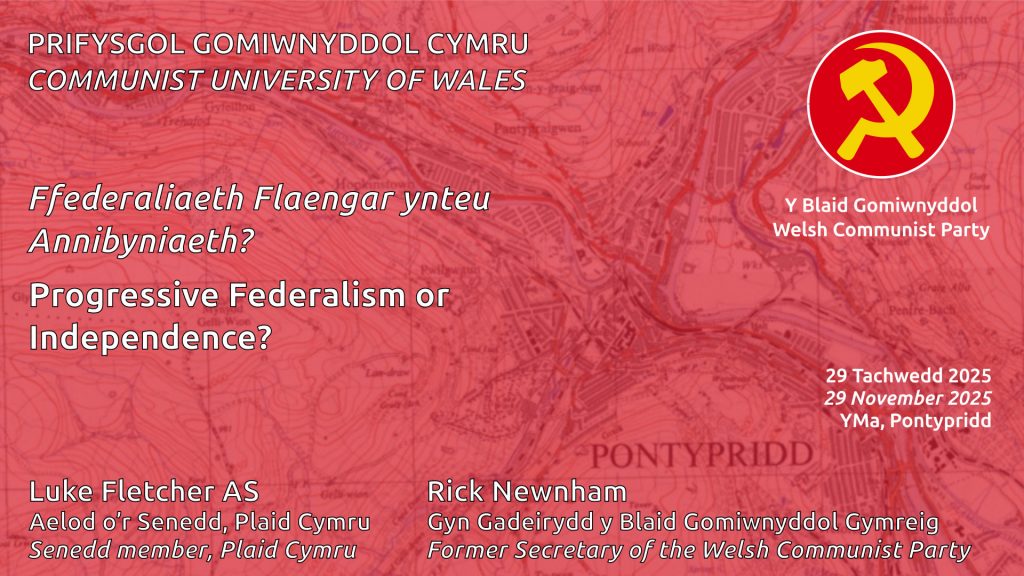
29th November 2025
YMa, Pontypridd
As part of the Communist University of Wales, Luke Fletcher and Rick Newnham discuss Independence and Progressive Federalism.
The full discussion is available on the Communist Party’s YouTube channel:
The text of Rick Newnham’s introduction to Progressive Federalism is included here:
The Great Divide – Class
All around the defining feature that confronts us is that of class. Internationally the global North is exploiting the South to the extent that 25% of the GDP in the North is derived from the exploitation of the South, though the possibility for the necessary decoupling for Southern countries is becoming more of a possibility as the hegemonic position of U.S. imperialism wanes. Indeed it is this fall from being the world’s only super power that is causing the US to generate global tensions in a final bid to maintain its supremacy.
Domestically we have been subject to a Ruling Class Offensive since the 1970s and we have experienced a growing level of inequality and poverty in Britain. And so it continues, as we saw from the budget, average disposal income is forecast to barely rise in the next five years. Yet this is not the case for the super rich where the top 50 families are now wealthier than the poorest 50% of population. Oxfam suggest the top 1% own 70% of the wealth! The divide is a class divide that is characterised by high levels of poverty across Britain, with the Midlands, London, and the North West at a slightly higher level than Wales according to Joseph Rowntree.
What is the nature of the British capitalist class that holds so much of the wealth? There has been a growth in the financial sector, particularly in terms of short term/ high return investments, allowing the wealth of the super rich to accelerate but cause a further reduction in strategic investment or planning. There has been an increase in the growth of fund management companies such as Blackrock who in Britain manage funds worth three times the amount of Britain’s largest company, Shell. Another key wealth generator for billionaires is property and inheritance. This is not surprising as land inequality is higher than overall wealth inequality. Land ownership is often very difficult to identify and in Wales there is no transparency. Tax rates of the declared wealth of the rich is woefully inadequate, yet much of the wealth is hidden. Taxation evasion is significantly higher than the stated £47 billion due to offshore tax evasion, estimated at hundreds of billions of tax lost in crown dependencies. Despite proclamations to the opposite virtually no improvement in offshore account transparency of the seven crown dependencies since the 2016 Act has occurred, with only Gibraltar complying. HMRC avoiding pursuing the ‘enablers’ of this evasion with only 5 prosecutions last year.
Any attempt to take on this parasitic class successfully is going to need the maximum of working class unity in action, as it always has from the Reform movement and Chartism in the Nineteenth Century, or the General Strike and the National Unemployed Workers Movement struggles of the first three decades of the twentieth Century. 98 years ago this month one of the NUWM marches stopped in this town on route to London from Maerdy. Again that unity was visible in the battles against the Heath government where Welsh pickets were present at the battle of Saltley Gates. The monumental struggle by the miners against Thatcher’s pit closure programme was the bitterest of class struggles, drawing working support from all areas of Britain. The unity has been evident in the anti war struggles of C.N.D., the Greenham Common women, Stop the War and more lately in support of Palestine. The fight against Fascism has been a long and varied struggle where perhaps the greatest unity occurred in World War II.
To challenge the capitalist class in both its British and Washington versions we will need to build an anti monopoly alliance with trade unions, community groups, single issue movements acting together, because every attempt to promote democracy or inequality will be resisted to the full. Any progressive independence movement will experience this in just the same way as an anti monopoly alliance will.
Progressive federalism is predicated on the need for an anti monopoly alliance that will attempt to extend democracy within Britain at national, regional and local levels. We need to reverse the dependency that smaller decision making bodies have on the larger ones; they require tax raising powers rather than being the default cutters of public services. But democracy must go further. All public bodies should be opened up to democratic process as a minimum, while any institution that has a bearing on the well-being of the public should be democratised or nationalised. At a British level a federal government should be aimed for to assist with co-ordination and the class defence which will be necessary to defend gains made against the capitalist class. Clearly this is some way off, and no amount of crystal board gazing can predict how things will pan out, so I suspect a progressive independence struggle and the anti monopoly alliance will share the same road for many years yet.
The House of Lords should be replaced by an elected second chamber and the royal family should be abolished and their assets nationalised.
Internationally, it is vitally important to strive to decouple from the Anglo-American imperialist project, both economically and militarily. This requires us to ditch NATO and the EU and propose a wider trading network and a purely defensive military.