

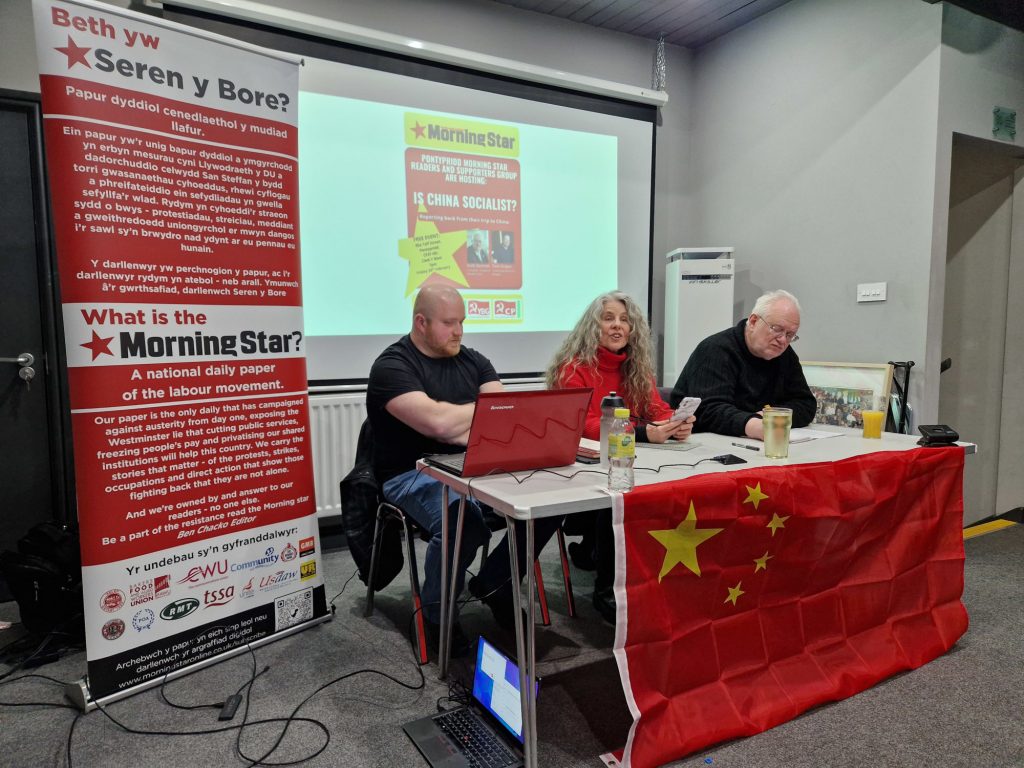
20 February 2026, 7pm
Clwb Y Bont, 85a Taff Street, Pontypridd, CF37 4SL
A recording of the talks given during the discussion on Socialism in China is now available on the Party’s YouTube channel and also below.
Twm Draper’s talk is included here:
I was fortunate enough to be sitting next to Keith when I was talking about Cuba and he was speaking about China at Welsh Party congress about 15 months ago. I said I wouldn’t mind visiting China and a few months later I had an email asking if I’d like to join the delegation!
China has always fascinated me, and I also wondered why we are that China are a threat to the west. So when the chance came up to see this threat, I thought aye why not.
So in May & June 2025 I visited China for 11 days for the first time and it was pretty incredible.
So the event today is titled ‘Is China Socialist?’ and I guess we should explore that.
There are many topics I could talk about today but I’ll have the chair telling me off and to stick to my allotted time so I’ll start with what struck me on a personal level when we got there.
China is a population of about 1.4 billion, but it didn’t feel cramped or unsafe at any point. So many of their buildings like train stations and outdoor spaces were built with convenience and serving the people in mind.
There were trees planted absolutely everywhere and this was all by design.
It was extremely clean, you didn’t have litter everywhere or years old chewing gum stuck to the floor. The delegation pulled off a few good drinking sessions and early morning cleaners would be out to beat the rush hour keeping the streets clean. There was a sense of pride in keeping their cities clean.
I think what also struck me was the friendliness of the Chinese and how proud they are of what China has achieved but also their understanding of the history of China. We visited the Great Wall of China one evening and they had lots of animations on the walls which I’ll be honest at first I thought was quite tacky, but as we went along actually it was incredible because it was aimed at Chinese tourists and it was telling the history of China throughout the centuries and it was all free! There were a number of families there with their kids interacting with the stories that were being told.
And this is one of the biggest contrasts that I saw between China and Britain is how they preserve their history and it’s accessible to everyone in public spaces. Just last week I went to see the film that Beth Winter had made ‘The coal beneath our feet, the wind above our heads’ and two school children who were interviewed as part of the film never knew about Tower Collery. This is such an important piece of working class history in the valleys and it was only in 2008 it closed. In comparison when we were in Dunhuang, Gansu province it was the Dragon Boat Festival and we attended the sand dunes and they used sand dunes opposite to project words of songs and had live performances as well. We climbed up the sand dunes the view was something else. It was also the best beer I’ve ever had.
There were around 10,000 people at this event, and it cost us nothing to attend. I asked one of the locals what the event was celebrating and it was a national holiday and they were able to explain the ancient story and tradition to me, and there was even a short video available on WeChat which showed you a brief history.
This event wasn’t a one off example of free spaces, we also visited Dunhuang seal buereau, printing press which at first just looked like a simple café but then we went downstairs and they had an area which was full of stamp making, pianos to be played and you can see I went a bit crazy on the stamps. This also cost me nothing!
I mentioned there were trees planted everywhere by design. There are a number of initiatives by the Communist Party of China to plant trees and increase forest coverage. It’s often called the Great Green Wall and serves multiple purposes. Whilst it is obviously helping with CO2 emissions, it also helps to prevent the spread of sandstorms etc. And in Jiayuguan in the desert the city had 42% green coverage, so it was really impressive to see and that no place was getting left behind.
We also visited the Dunhuang Salt Tower CSP Plant which is a major breakthrough in renewable energy. They had 12,000 solar panels making it the biggest solar panel site in the world. Then gets fed into electric grid and reliable source of energy.
Whilst we were in Jiayuguan, we were joined by a university teacher who lived there all his life and he explained the changes he had seen and in the last 30 years that his salary had increased 40 times. I asked him what he thought about the changes he had seen and witnessed and, in his words, it made him ‘very proud and satisfied’. And this was a common theme when I would speak to locals and at events, they understood the goal and common prosperity.
And that brings me on the last point I want to cover around how China deal with contradictions and common prosperity.
We can see there are many things that China is doing that we are not, and why is that? Well, the main thing is to give everyone in China a better life. In 1949 they went from a peasant country where famine was a yearly ordeal to lifting 800 million people out of extreme poverty by 2020. They set a goal to eradicate extreme poverty within 100 years of the founding of the CPC (1921) and they did. And this isn’t a statistic from some Chinese run institute, this is the world bank confirming this.
China of course had a period of industrialisation which did mean there was a cost to the environment, but there are two things to ask yourself:
- What were they trying to achieve? (I’ll give you the answer)
- Compared to Britain, are we really going to pretend that Britain didn’t have its own industrialisation programme which spanned a far longer programme than it was in China?
Let’s look at what this achieved in China. It tackled poverty, illiteracy, built up a health service which actually functions and had to deal with the aftermath of a civil war and imperialist powers interfering in China.
In Wales, literacy rates are actually going down, 31% of children in Wales live in poverty and 26% of those are in working households and all we see is tax payers money going on an ever increasing ‘defence budget’.
And when China and the CPC are dealing with contradictions, these are things that are being weighed up. What was the main issue to deal with, lifting people out of extreme poverty.
But that’s not to say they are doing nothing about the climate impact now, the initiatives I mentioned already show that China’s CO2 emissions are actually starting to trend downwards so they are well ahead of their target which they said they would peak CO2 emissions by 2030. These are tangible outcomes that demonstrate they put their words into action.
The effects on the environment have not been ignored by the CPC. General Secretary Xi Jinping stated: “We must strike a balance between economic growth and environmental protection. We will be more conscientious in promoting green, circular and low-carbon development. We will never again seek economic growth at the cost of the environment.”
The reason they can achieve this is they rather than capital ruling the people like in Britain, in China, the people rule the capital, invest in infrastructure, renewable energy and raise people out of poverty.
I would encourage anyone to visit China to experience it first-hand and to answer the question ‘Is China Socialist?’. Well I would say so.
Thank you